A trip to Experimentarium
The project aims to build a Danish-UK knowledge exchange focused on children’s play in health spaces. It builds on the work Dr Dylan Yamada-Rice, Dr Jill Thompson and design agency Dubit have done in preparing children for an MRI scan using a physical play toolkit and an accompanying app.
I visited Copenhagen for a week-long trip in October 2023 with Dr Dylan Yamada- Rice to learn more about how the Danish approach play in children’s spaces with a specific focus on health.
The Experimentarium is a large science centre based just outside central Copenhagen. I was interested to see how it explores the topic of health for a family audience and the way in which play is used to engage, educate and explore this topic.
Looking at real bodies
Children and their families could get hands-on through live scheduled demonstrations that looked at body parts in detail. For example, dissecting an eyeball.
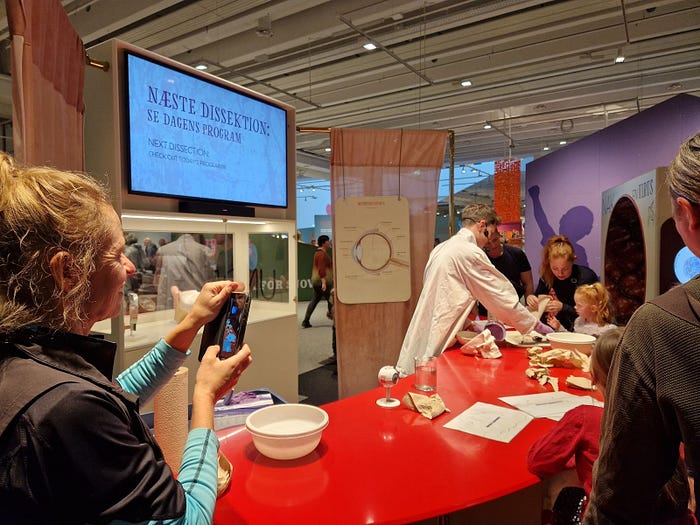
Example of live demonstration
I thought this approach was really interesting — that children could see how an eyeball is constructed and not just as an animation or diagram which is much more abstract. Showing what bodies really look like is something that programmes like Operation Ouch do brilliantly — giving those watching an opportunity to look away if they are feeling sensitive, but allowing the curious to look and learn more deeply. In the same way children who were interested could get involved in the demos — either by watching, or touching or joining in.
All about me
Many of the interactive exhibits started with a personal challenge to explore the body more widely. For example, rather than telling you the importance of keeping fit, there were chances to test yourself.
- How fit are you?
- How high can you jump?
- How fast are your reactions?
The reaction test counted how quickly you could hit the lights when they lit up in a time limit.
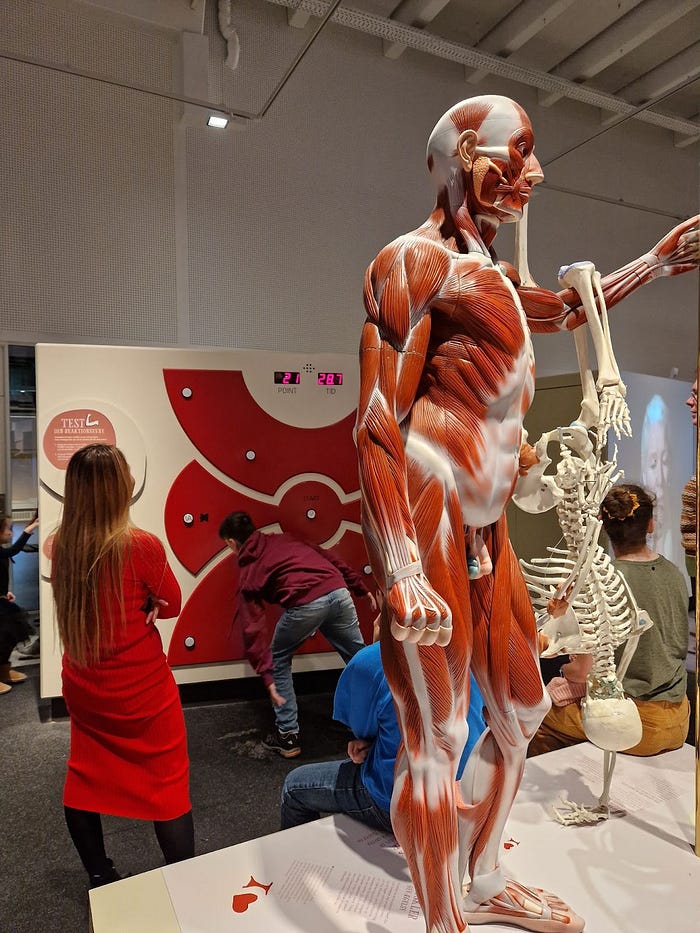
Example of reaction test
The jump test asked you (as a group) to jump on the same spot to measure how high you can jump. After offering a tip to jump higher, there was an opportunity to try again.
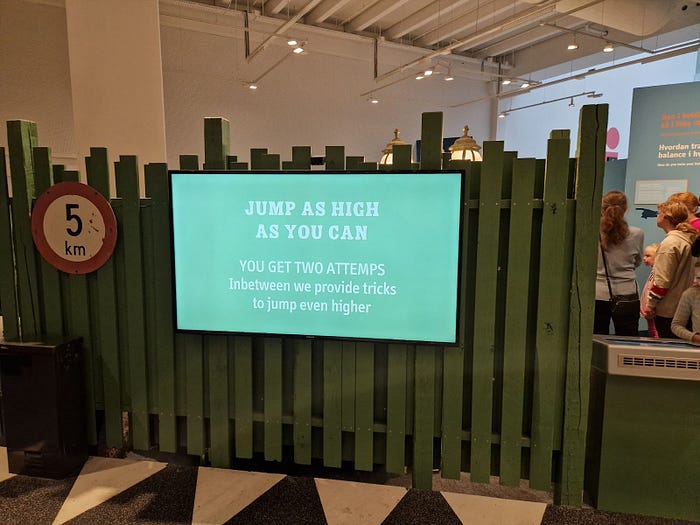
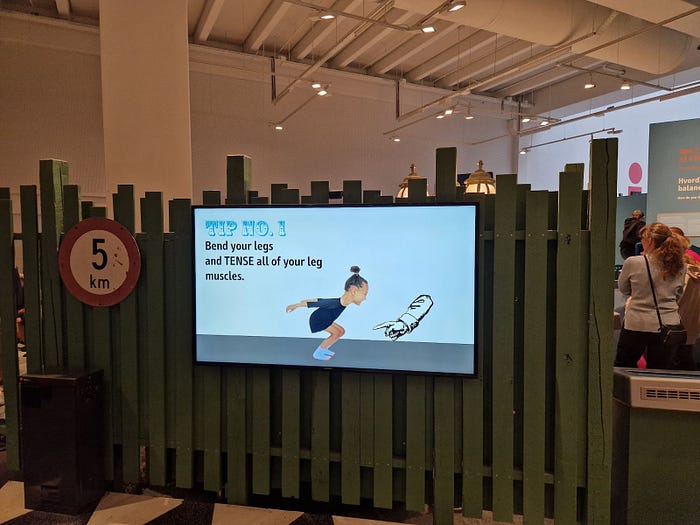
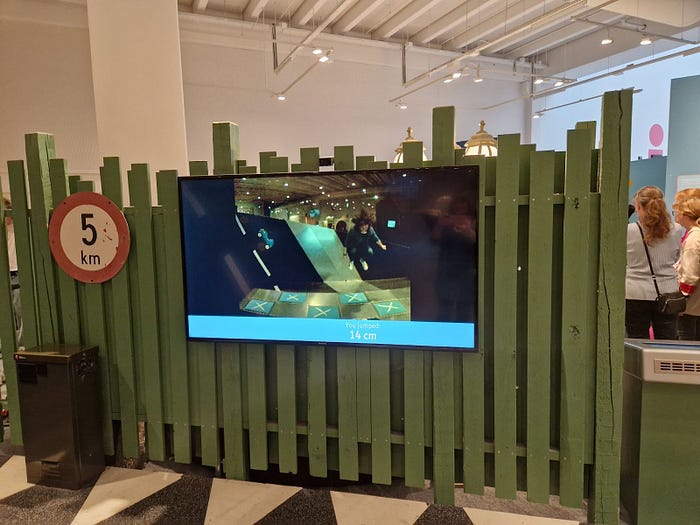
I jumped from 8cm to 14cm with the top tip!
These gave you appropriate feedback and a live action replay of yourself along with your result.
Each approach to these topics were playful and game-like which also made it fun to participate. It offered an additional chance to engage with the content by being a spectator. There were queues for all these exhibits.
Starting from ‘me’ to explore the topic is a great way of engaging children (and their families) as they compare results with each other too. This was more formally recognised at the museum as families could create an account which recorded all the results of their challenges to take home.
Using playful surprises
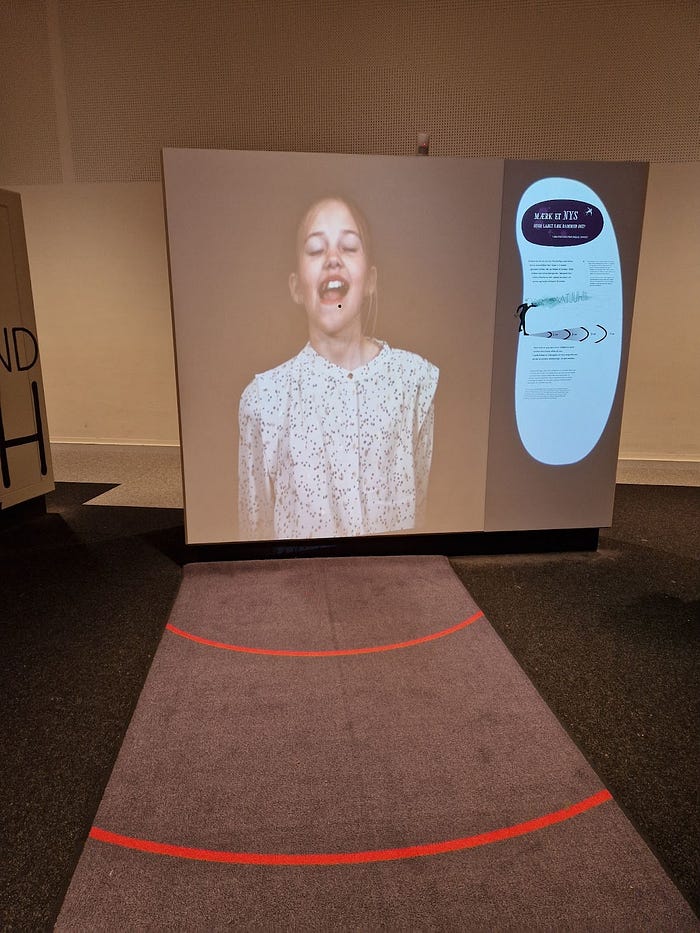
Sneezing interactive
Using playful surprises to engage young people with a health topic were very effective. In one exhibit, a video of different people sneezing in slow motion resulted in a water spray coming out of the screen.
I watched many children start at the red lines and get closer each time as though daring themselves to get sprayed. Some bolder children found where it was coming from and stood there for each sneeze.
Even though it was only water, coupled with the film it really felt as though you are getting sprayed by someone’s sneeze which has the delightful suggestion of being utterly revolting! Something that obviously appealed to the children too.
Talking about death
A powerful exhibit for me was one that about heat. A large upright screen showed how hot the bodies of the people going past on the other side of the screen were.
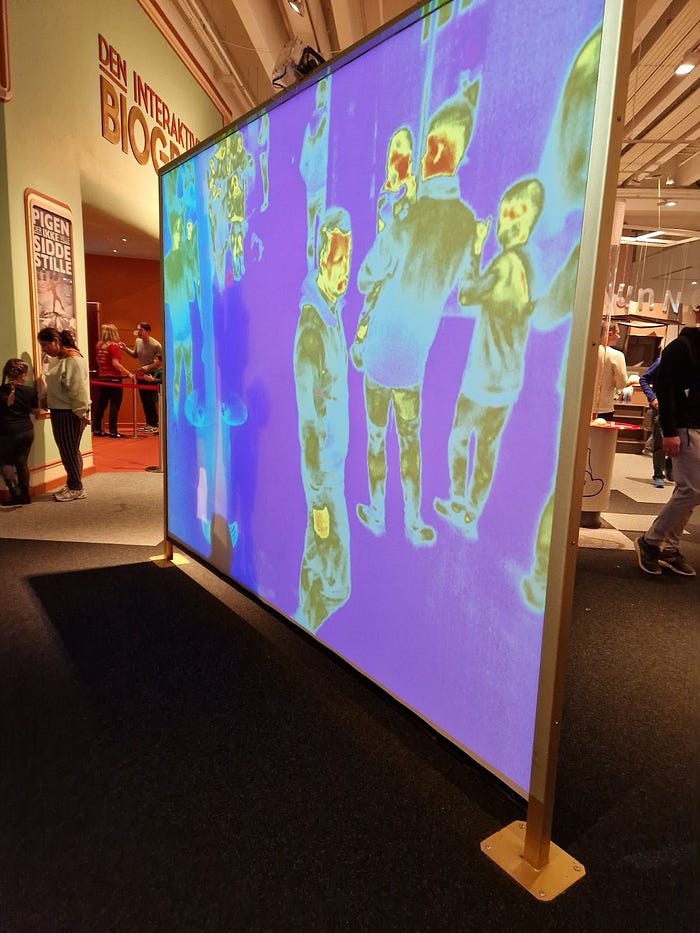
Example of heat map
In contrast, a loopable video showed the heat leaving someone who had passed away. It was projected on a large stone table and provided a striking contrast with the live screen.
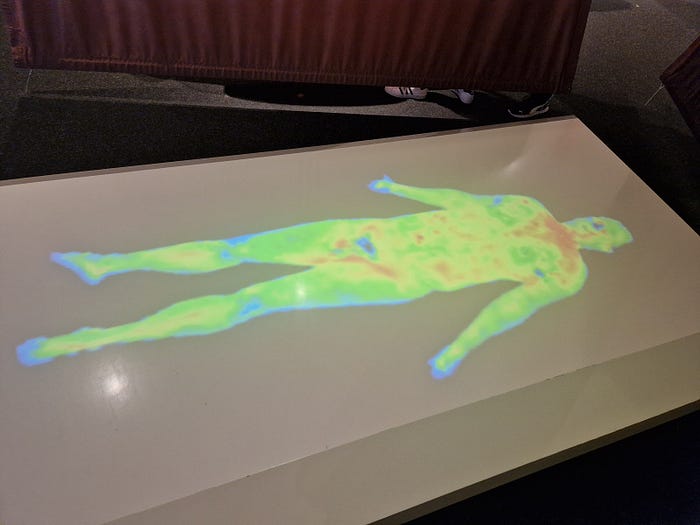
Example of heat map projection showing someone who has died
I watched as some children climbed onto the table and lay down on the projection. I found it interesting that those who are ready to know what death means will take what they need from it, but it can be completely ignored by those younger who don’t yet understand — instead made into a playful opportunity instead. The subtly I think is the key here and it was sensitively presented (as an abstract heat map rather than something more identifiable to the person’s likeness).
Conclusions
Engaging children and their families in learning more about health is not a one size fits all approach. It depends on the needs of the child — their age, sensitivity and how they want to participate. However, these are my main takeaways for developing engaging health content for a family audience:
- Start with me — starting with a known point (the child) is a really good way of engaging and personalising a health topic to have relevance and meaning. After that you can explore the topic more broadly. For example — how high can you jump? Here is some information about how we use our body to jump, now try again using what you have learnt.
- Don’t be afraid to show reality for those who want it — sensitively dealing with issues that families may feel uncomfortable with (for example inside our bodies showing blood, or what happens when you die) can be really important to offer. Allowing opportunities for those to ‘look away’ if they are not ready is better than not doing it at all.
- Use surprises and play to engage — it really is fun to find out something new by playing. Thinking playful and creatively about how a topic might engage children is really important — even if it does mean being sneezed on!